
🎯 Stop 5 AM wake-ups today download our app FREE for 7 days
✓ Turn any phone into a sleep training clock
✓ Red-green method proven in 5-7 nights
✓ FREE 7 days trial
⭐⭐⭐⭐⭐ Rated 4.8 by parents
Is 5 AM your new alarm clock? If your toddler is up before the sun, you’re not alone. Early morning wake-ups are one of the most common – and most exhausting – sleep challenges parents face.
The good news? It’s fixable. Most parents see dramatic improvement within 3-7 days using the right approach.
In this guide, you’ll discover:
- The 5 science-backed reasons toddlers wake too early
- Common mistakes that make it worse
- A proven 5-step solution that works in less than a week
- When to expect results (and what to do if it’s not working)
Let’s help you get your mornings back.
Quick answer: Why does my toddler wake up at 5am?
Toddlers wake at 5am because their circadian rhythm has drifted – sleep pressure is low after 9-11 hours of sleep, cortisol naturally rises between 4-6am, and even faint light cues (streetlight, hallway, early sunrise) signal “morning” to a toddler’s brain. Most 5am wake-ups can be reset within 3 to 7 days by combining a slightly later bedtime, a blackout-dark sleep environment, a clear visual sleep cue, and consistent low-energy response when they wake early.
The problem: why 5AM feels so brutal
Here’s the thing about 5 AM wake-ups: it’s not just about losing an hour of sleep. It’s about:
- Starting your day exhausted before it even begins
- The domino effect on naps, bedtime, and your toddler’s mood
- No time for yourself in the morning
- The feeling that you have no control over your own schedule
One parent described it perfectly: “I feel like I’m living in a different time zone than the rest of the world.”
But here’s what most parents don’t realize: Your toddler isn’t waking up at 5 AM to torture you. There are specific biological and environmental reasons – and once you understand them, you can fix them.

The science behind 5 AM wake-ups
Your toddler’s body is controlled by their circadian rhythm – their internal 24-hour clock. Here’s what’s happening at 5 AM:
1. Sleep pressure has decreased
By 5 AM, your toddler has been asleep for 9-11 hours. Their “sleep tank” is nearly empty, making them more likely to wake from lighter sleep stages.
Why it matters: If bedtime is too early (before 7 PM), their body naturally wakes after a full sleep cycle – even if it’s still dark outside.
2. Cortisol levels rise
Around 4-6 AM, your body produces cortisol (the “wake-up hormone”) to prepare for the day. In toddlers with disrupted circadian rhythms, this surge can trigger waking.
3. Light cues are confusing
Even small amounts of light (streetlights, early sunrise, hallway light under the door) can signal “morning” to your toddler’s brain.
The fix: Blackout curtains + a visual sleep trainer that clearly shows “it’s still sleep time.”
4. Hunger or thirst
If your toddler goes to bed without adequate calories or hydration, they may wake genuinely hungry or thirsty.
5. Habit loop
After waking at 5 AM for several days, your toddler’s body starts to expect it. Their circadian rhythm shifts to match the new wake time – even if you want them to sleep longer.
Bottom line: 5 AM wake-ups aren’t a personality trait. They’re a pattern – and patterns can be changed.

5 common mistakes parents make (that make it worse)
Before we get to the solution, let’s talk about what NOT to do:
❌ Mistake #1: Going in too soon
The moment you hear your toddler at 5 AM, your instinct is to rush in. But this reinforces the behavior. Your toddler learns: “If I wake up and call out, Mom/Dad comes immediately.”
Better approach: Wait 5-10 minutes to see if they self-soothe back to sleep.
❌ Mistake #2: Starting the day at 5 AM
Turning on lights, getting them out of their crib, or offering breakfast signals: “5 AM is morning.” Even if you’re exhausted and just want to survive, this locks in the early wake-up.
❌ Mistake #3: Inconsistent wake times
Letting your toddler “sleep in” on weekends or after a bad night confuses their circadian rhythm. Their body doesn’t know when morning actually starts.
The fix: Same wake time every day (even weekends) until the pattern is fixed.
❌ Mistake #4: Bedtime is too early
If your toddler goes to bed at 6:30 PM and wakes at 5:00 AM, they’ve gotten 10.5 hours of sleep – which might be enough for their body. You’re not dealing with a sleep problem; you’re dealing with a math problem.
❌ Mistake #5: No visual sleep cue
Toddlers can’t tell time. They don’t understand “it’s still nighttime.” Without a clear visual cue (like a sleep training clock or the Red Light Green Light method), they have no way to know they should stay in bed.
The 5-step solution to fix 5 AM wake-ups
Here’s the proven system that works for most families in 3-7 days:
Step 1: Optimize bedtime
Target bedtime: 7:00-7:30 PM for most toddlers aged 1-3 years.
- Too early (before 7 PM) = early morning wake-ups
- Too late (after 8 PM) = overtired, harder to fall asleep
How to adjust: Shift bedtime by 15 minutes every 2-3 days until you hit the sweet spot.
Step 2: Create “blackout dark” sleep environment
Your toddler’s room should be cave-dark – so dark you can’t see your hand in front of your face.
Invest in:
- Blackout curtains or shades
- Cover any LED lights (baby monitors, humidifiers)
- Block light from under the door with a towel
Cost: $30-50 for quality blackout curtains. Worth every penny.
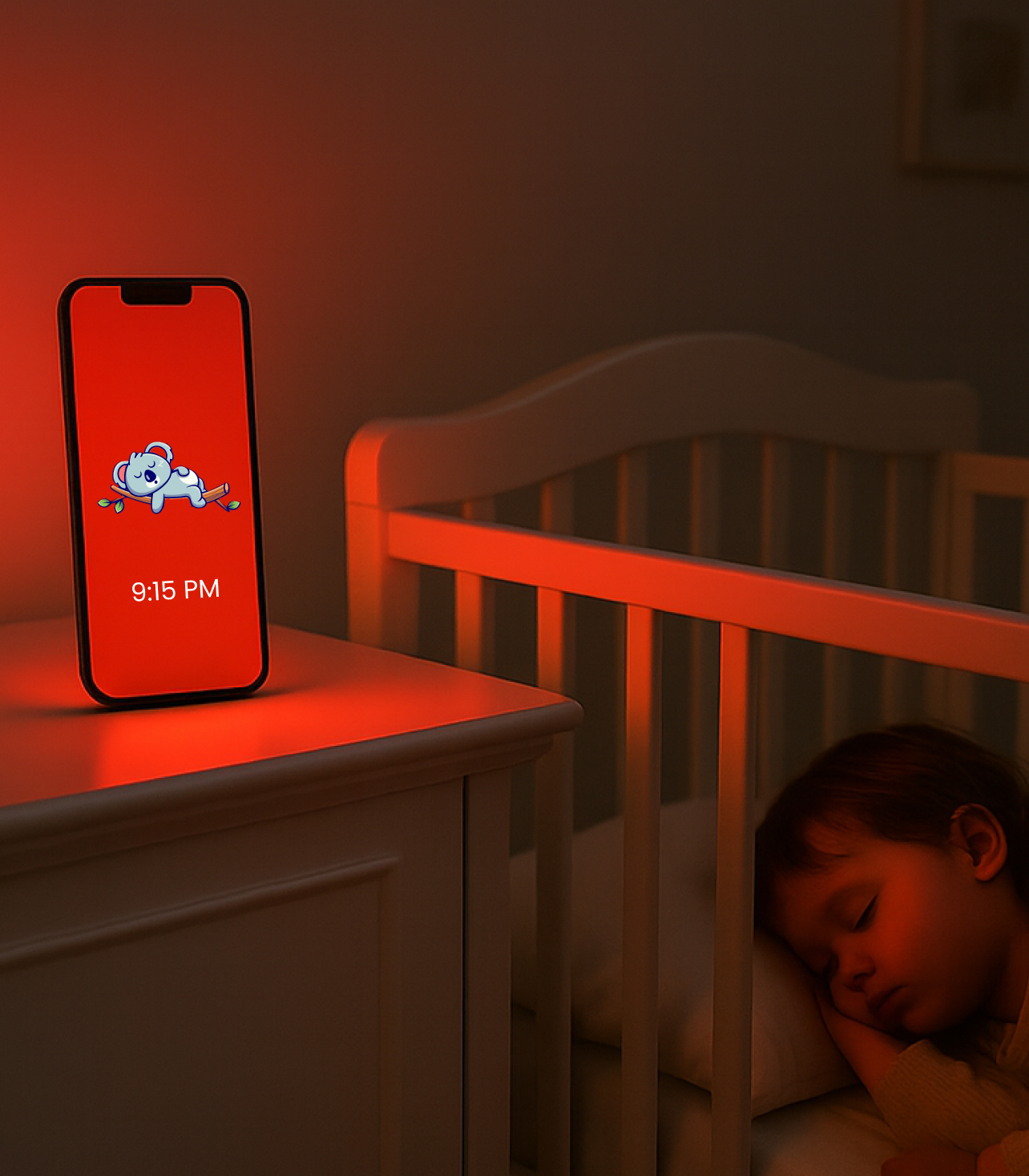
Step 3: Use a Vvisual sleep trainer
This is the game-changer. Toddlers are visual learners. A sleep training clock or app shows them:
- Red light = Stay in bed, it’s still sleep time
- Green light = It’s morning, you can get up!
Why it works: Takes the guessing out of “when can I get up?” Your toddler learns to wait for the green light.
Research on behavioral sleep training consistently shows improvement within the first week of consistent implementation. (Scientific American)
Best option: The Red Light Green Light sleep training app turns any iPhone or iPad into a sleep trainer. No need to buy expensive hardware ($40-80).
Step 4: Stay consistent (the hardest part)
For the first 3-7 days:
- Don’t go in before the green light (even if they’re calling for you)
- Same wake time every day (even weekends)
- Same bedtime routine every night
You can call out reassuringly: “The light is still red! It’s still sleep time. When it turns green, Mommy will come get you.”
What to expect:
- Days 1-3: Resistance, crying, frustration
- Days 4-5: Testing the boundaries
- Days 6-7: They start waiting for the green light
Step 5: Adjust wake time gradually
Start with your toddler’s current wake time (5:00 AM). Set the “green light” for 5:00 AM initially.
Once they consistently wait for the green light, shift it by 10-15 minutes every 2-3 days:
- Days 1-3: Green light at 5:00 AM
- Days 4-6: Green light at 5:15 AM
- Days 7-9: Green light at 5:30 AM
- Days 10-12: Green light at 5:45 AM
- Days 13+: Green light at 6:00 AM (goal!)
Pro tip: Don’t rush this. Slow and steady wins.
What if it’s not working?
If you’ve tried everything for 2+ weeks with no improvement, consider these factors:
1. Check for sleep regressions
18-month and 2-year sleep regressions can temporarily disrupt patterns. These usually last 2-4 weeks.
2. Rule out medical issues
- Sleep apnea
- Acid reflux
- Ear infections
- Allergies
If your toddler seems uncomfortable or in pain, see your pediatrician.
3. Evaluate total sleep needs
Some toddlers genuinely need less sleep. If your toddler is:
- Happy and energetic all day
- Napping well
- Going to bed easily
They might just be an early bird. In that case, adjust YOUR schedule instead of fighting their biology.
4. Consider room-sharing
If your toddler shares a room with a sibling, early wake-ups can be trickier. You may need:
- White noise machines (one for each bed)
- Separate sleep training clocks
- Staggered wake times
Timeline: When to expect results
Days 1-3: Rough. Your toddler will resist. Stay strong.
Days 4-5: You’ll see glimmers of hope. They’re learning.
Days 6-7: Most parents report success. Your toddler waits for the green light!
Week 2+: The new pattern becomes automatic.
Success rate: 80-85% of parents see improvement within 7 days when following this method consistently.
Real parent success story
“We were at our breaking point. Every. Single. Morning. 5:15 AM like clockwork. I tried everything – earlier bedtime, later bedtime, cutting naps – nothing worked.
Then I found the Red Light Green Light app and committed to the plan. The first 3 days were HARD. My daughter cried, we were exhausted. But on Day 4, she waited. On Day 7, she didn’t even call out until the green light.
Now she sleeps until 6:30 AM every day. I feel like a new person.”
– Sarah M., Mom of 2-year-old

Ready to get your mornings back?
The 5 AM wake-up cycle doesn’t have to be your reality. With the right approach – consistent wake times, a dark room, and a visual sleep trainer – most families see results in less than a week.
Start tonight:
- Set a consistent bedtime (7:00-7:30 PM)
- Make the room cave-dark
- Download the Red Light Green Light app (free 7-day trial)
- Commit to the plan for 7 days
You’ve got this. Better mornings are just a few days away.
Download the app: Turn any iPhone or iPad into a sleep trainer that helps your toddler understand when it’s time to wake up. Get it free for 7 days →
Frequently Asked Questions
Is it normal for a toddler to wake at 5am?
It’s common – but it’s not biologically inevitable. The vast majority of 5am wake-ups are a habit pattern caused by some combination of light cues, bedtime timing, and learned response, not a fixed personality trait. With consistent changes most families see improvement within 3-7 days.
How long does it take to fix 5am wake-ups?
Most families see meaningful improvement in 3-7 nights using a consistent approach (later bedtime if needed, blackout room, clear visual sleep cue, no early-morning rewards). Some toddlers reset in just 2-3 nights once the underlying cause is addressed. If nothing has changed after 14 days, the issue is usually something more specific – review the “What If It’s Not Working?” section above.
My 1 year old wakes up at 5am – is that normal?
At 12 months a 5am wake is usually one of three things: bedtime is too early, the morning nap is too long, or you’re in the middle of the 12-month sleep regression. Try shifting bedtime later by 15-minute increments and capping the morning nap at 60-90 minutes.
Why does my 18 month old wake up at 5am?
The 18-month sleep regression is real and well-documented – driven by language explosion, separation anxiety, and molar teething. The most common fix is checking that the awake window before bedtime is 5-6 hours. If your toddler naps until 3 PM and goes to bed at 7 PM, that’s not enough sleep pressure to bridge the night.
Should I keep my toddler awake longer to fix 5am wake-ups?
Not usually – making them more tired often backfires by raising cortisol and creating more fragmented sleep. The goal is the right amount of sleep pressure: bedtime late enough that they fall asleep within 15-20 minutes, but not so late they’re overtired. For most toddlers that’s 7-7:30 PM with a single afternoon nap.
My 2 year old wakes at 5am crying – what should I do?
Stay consistent. The hardest part of fixing 5am wake-ups is the 2-3 days where your toddler protests the new routine. Don’t go in before your set wake time; don’t start the day at 5am even once. Brief reassurance (“the light is still red, I’ll see you when it’s morning”) and exit. Most 2 year olds adjust within a week.
When does the 5am wake-up phase end?
There’s no single age when it ends – many families never have a 5am wake-up phase, and some kids regress at 18 months, 2 years, and 3 years for different reasons. The pattern always responds to schedule and environment changes; what makes it stick is consistent execution over a full week.
Is 5am too early to start the day?
For most families, yes. Toddlers need 11-13 hours of total sleep; if bedtime is 7 PM, the natural wake should be 6-6:30 AM at the earliest. A 5am wake means they’re getting only 10 hours, which leads to overtiredness, which leads to harder bedtimes the next night – a vicious cycle. Aim to push wake time to at least 6 AM before declaring the day started.


Leave a Reply