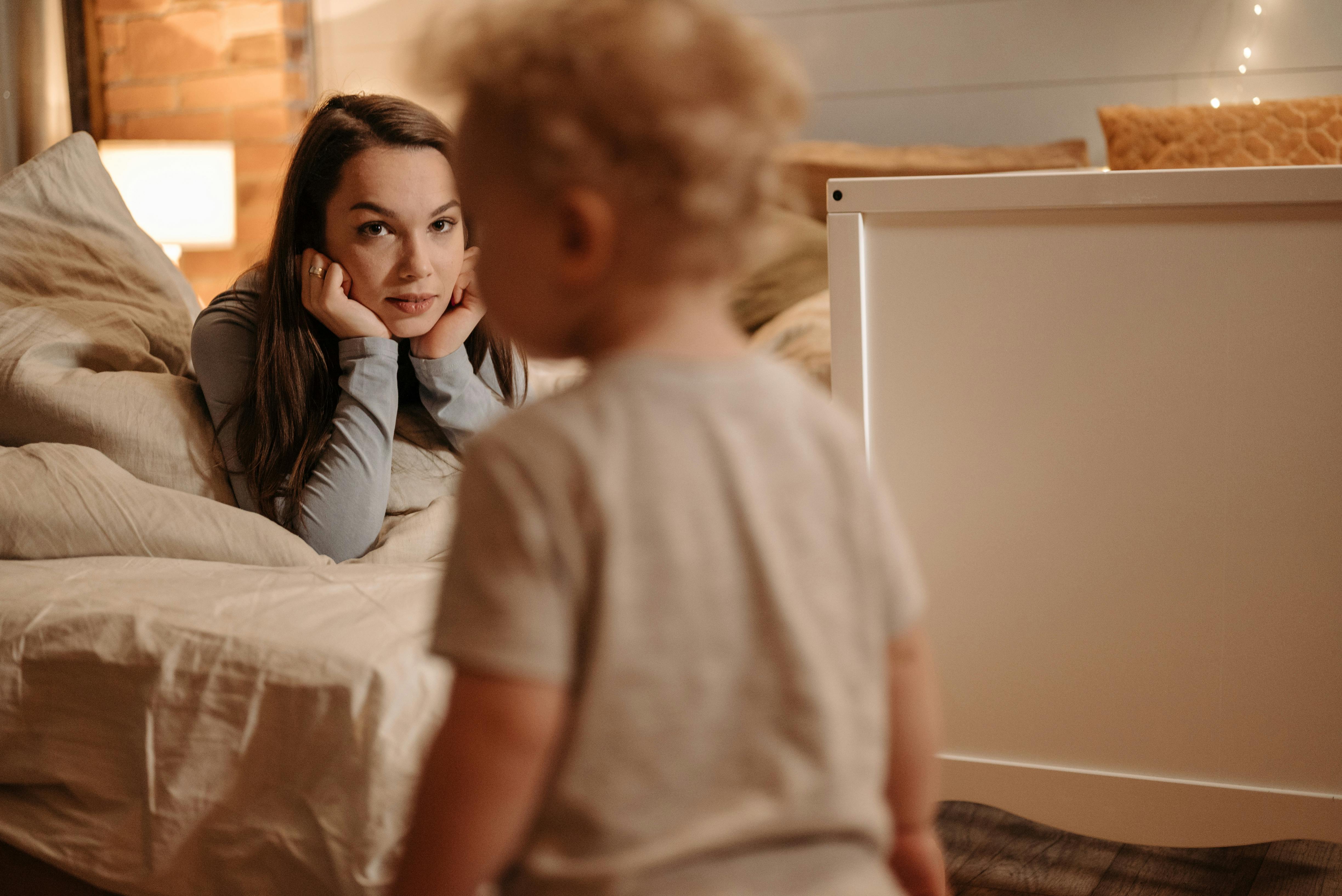
It’s 2:47 AM. You’re standing in the doorway of your toddler’s again, wondering how someone so small can have such an enormous resistance to sleep.
You love them fiercely. You also desperately need them to close their eyes.
If this sounds like your nights, here’s something nobody tells
exhausted parents early enough: you are not doing anything
wrong. Your toddler is not broken. And you are far from
alone.
Science has actually been studying this exact problem for decades.
The findings might surprise you – and more importantly, they might
finally help you stop blaming yourself.
The numbers (that will make you feel better immediately)
Let’s start with the raw data, because nothing normalizes parental
exhaustion quite like realizing how many other families are awake at
2:47 AM with you.
How many toddlers actually sleep through the
night?
- Only 38% of three-year-olds consistently sleep
through the night without waking - At six months, just 16% of babies sleep
uninterrupted - 6.5% of three-year-olds still wake every single
night – even at that age - Nearly half of all parents report their child falls
asleep in one place and ends up in another by morning
Let that sink in. At age THREE – when most parents assume sleep
problems are long behind them – fewer than 4 in 10 children reliably
sleep through.
The uncomfortable truth: Uninterrupted toddler sleep
is the exception, not the rule. If your child wakes at night, they are
in the majority.

Why toddler brains are wired against sleep (it’s not personal)
Understanding why toddlers resist sleep makes it much easier
to respond – and to stop taking it as a personal failure.
1. Their sleep cycles
are shorter than Yours
Adults cycle through light and deep sleep roughly every 90 minutes.
Toddlers? Every 50-60 minutes. Every time they surface
from deep sleep into a lighter stage, there’s an opportunity to wake
fully – especially if they need help getting back to sleep.
The fix: Teaching your toddler to self-settle at the
start of the night means they can reconnect those sleep cycles
independently at 2 AM.
2. Their brains are literally growing during the night
Sleep is when toddlers process everything they learned that day.
Every new word, every step, every emotion gets filed away during sleep.
An actively developing brain is a restless brain.
Research consistently shows that cognitive and motor
development peaks correlate directly with sleep disruption. In
other words: the smarter and more capable your toddler becomes, the
worse they may sleep – temporarily.
3. Separation anxiety is
biological
Between 12-24 months, most toddlers develop a deep, instinctual
awareness that you can disappear. Evolution wired this in as a survival
mechanism – infants who screamed when separated from caregivers
survived. Ones who didn’t, didn’t.
Your toddler isn’t being manipulative at 11 PM. They’re experiencing
a genuine, biologically-driven anxiety response. Their brain is doing
exactly what it evolved to do.
The reassurance: Responsive parenting during this
phase – acknowledging their fear while maintaining boundaries — actually
shortens this period rather than extending it.
Sleep
regressions: every milestone has a price
If sleep was going well and then suddenly fell apart, you’ve almost
certainly hit a sleep regression.
These predictable disruptions occur when your toddler’s brain
undergoes a significant developmental leap:
| Age | What’s Happening | Duration |
|---|---|---|
| 8-10 months | Crawling, object permanence, separation anxiety | 2-6 weeks |
| 12 months | Walking, language explosion | 2-4 weeks |
| 18 months | Autonomy, vocabulary doubling | 2-6 weeks |
| 2 years | Imagination, complex emotions, testing limits | 2-6 weeks |
| 3 years | Nightmares begin, logic develops | 2-4 weeks |
Important: A sleep regression is not a sign you need
to start sleep training from scratch. It’s a temporary disruption.
Consistency through it is key.
One study found that babies who had just started crawling woke for an
average of 10 minutes longer per night episode than
non-crawlers. The skill acquisition literally interrupts sleep. Once the
skill consolidates, sleep typically improves – if you don’t
accidentally create new sleep associations during the regression.

“First
sleep” and “second sleep” – how humans used to sleep
Here’s something that reframes everything: humans didn’t
always sleep in one long stretch.
Historical records from before artificial lighting describe a
near-universal pattern called “first sleep” and “second
sleep.” People would sleep for 3-4 hours, wake for 1-2 hours of
quiet activity – reading, prayer, conversation – then return for a
second 3-4 hour stretch.
This biphasic sleep pattern was completely normal for most of human
history. The expectation of one uninterrupted 8-hour block is actually a
modern invention, driven by artificial light and industrial work
schedules.
What this means for your toddler: Their midnight
waking might be partially rooted in ancient biology – not bad parenting,
not a broken sleep schedule.
Of course, this doesn’t make 2 AM much more fun. But it does mean you
can stop wondering what you did wrong.

The one
thing that actually helps: a clear sleep signal
So if wake-ups are biologically normal, what separates the toddlers
who go back to sleep independently from those who need parental
intervention every time?
The answer, consistently supported by research: knowing when
it’s okay to be awake.
Toddlers who understand “it’s still sleep time” versus “morning is
here” can self-soothe back to sleep after a natural wake-up. Those who
can’t tell the difference – because toddlers genuinely cannot read
clocks or understand time – are stuck. They wake up, feel uncertain, and
do the only reasonable thing: call for you.
This is exactly why the visual sleep cue method
works so well for toddlers:
- Red light = Stay in bed, it’s still sleep time
- Green light = Morning has arrived, you can get
up
It gives toddlers something concrete to reference when they wake at 3
AM. Instead of uncertainty (which triggers calling out), they see the
red light and know: not yet.
Most families see results within 3-7 days of
consistent implementation – not because they’ve suppressed their child’s
natural wake-ups, but because they’ve given their child the tools to
navigate those wake-ups independently.
What “independent
sleep” actually looks like
Let’s clear up a common misconception: sleep training doesn’t
mean your toddler never wakes up.
It means:
- They wake (normal, biological, inevitable)
- They check their cue (red light still on)
- They settle themselves back to sleep (independently)
- You don’t hear about it
This is the realistic, science-backed goal. Not elimination of waking
– management of waking.
Parents who implement a consistent visual sleep cue system regularly
report:
- Toddlers waking but not calling out
- Earlier bedtimes accepted more easily
- Nap transitions becoming smoother
- The dreaded 5 AM wake-up shifting later within a week
The permission you
didn’t know you needed
Here’s what the science really says:
Your toddler waking at night is normal. The
statistics prove it. The developmental research confirms it. Human
evolutionary history validates it.
You haven’t failed. You haven’t spoiled them. You haven’t created an
unfixable problem.
What you can do is give them the tools to navigate their
biological wake-ups without needing you every single time – and that
starts with a clear, visual signal they can understand at 2 years
old.
The goal isn’t a perfect sleeper. It’s a toddler who wakes, checks
the light, and thinks: not yet.
And then goes back to sleep.

Try the
Red Light Green Light method free for 7 Days
The Baby Sleep Training Coach app turns any iPhone
or iPad into a visual sleep trainer – giving your toddler the clear
signal they need to understand “sleep time” vs. “wake time.”
What you get:
- ✅ Red/green light system based on proven visual cue method
- ✅ 15+ soothing sounds and lullabies
- ✅ Engaging animations your toddler will actually watch
- ✅ Customizable timers for naps and bedtime
- ✅ Works on any iOS device (even that old iPhone in the drawer)
• Free 7-day trial
We built this app as exhausted parents who tested every method on
our own toddler first. The red-green method is what finally worked for
us – and we wanted to make it accessible for every family.


Leave a Reply